
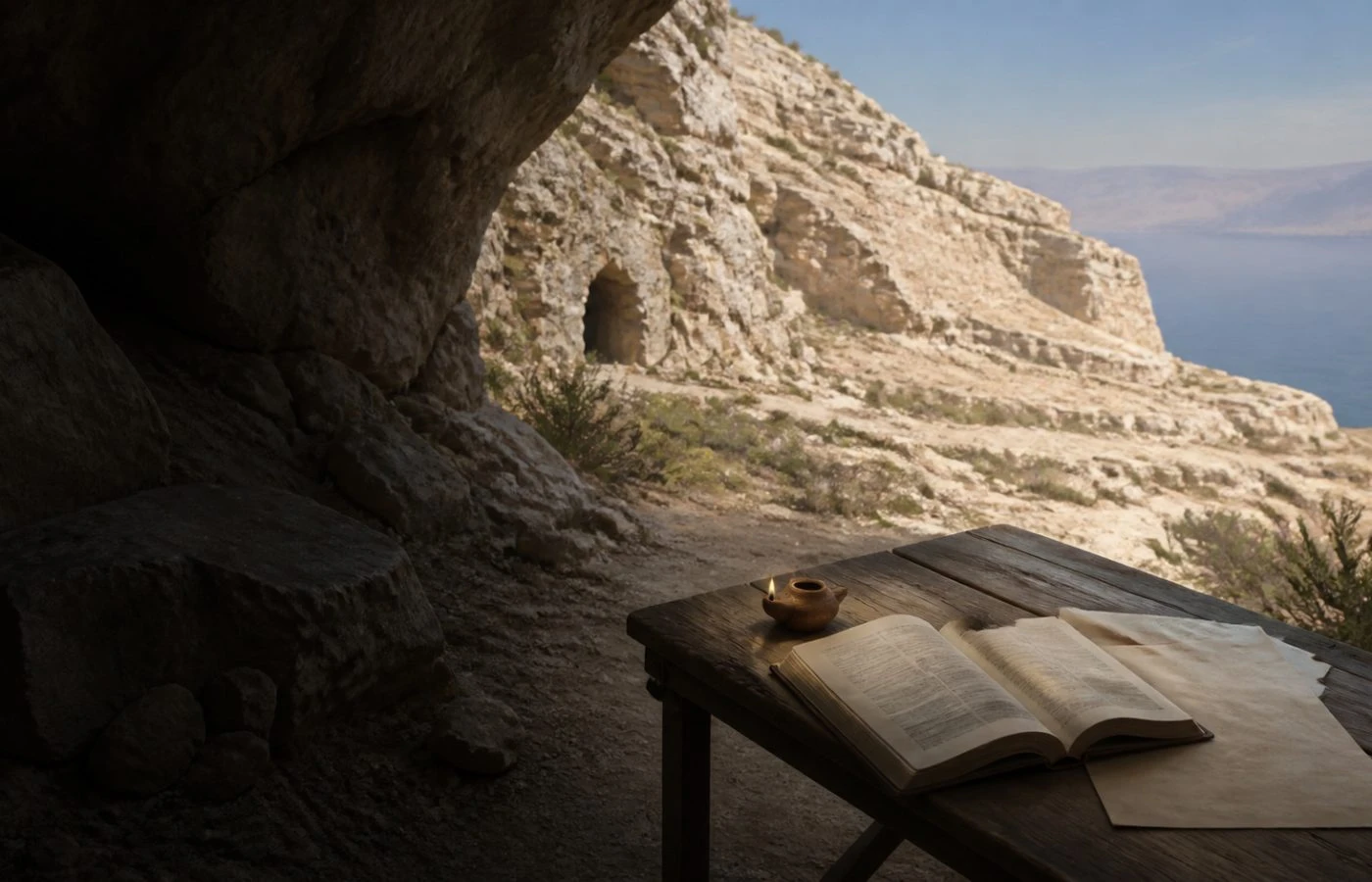
Short answer: There is no direct biblical or historical proof that John the Baptist was a member of the Qumran community. The comparison exists because John preached in the wilderness, called people to repentance, and lived an austere life, while the community associated with Qumran also expected God’s decisive intervention. The similarities are interesting, but they do not establish that John lived at Qumran.
What is Qumran?
Qumran is an archaeological site on the northwestern shore of the Dead Sea. The nearby caves became famous after the discovery of the Dead Sea Scrolls in the late 1940s. The scrolls include biblical manuscripts and other Jewish writings from the Second Temple period, the era before and around the beginnings of Christianity.
Many scholars connect the settlement at Qumran with an Essene or Essene-like movement, although the identification and interpretation of the site remain debated. It is safer to speak about the community associated with Qumran than to treat every detail of the Essenes as certain.
Why people compare John the Baptist with Qumran
A wilderness setting
The Gospels place John in the wilderness near the Jordan, calling people to repentance and baptism (Matthew 3:1–12; Mark 1:2–8; Luke 3:1–20). Qumran was also located in a stark desert environment. Geography alone does not prove a relationship, but it helps explain why the comparison has attracted attention.
A disciplined way of life
John’s clothing and diet are described in Matthew 3:4 and Mark 1:6. Ancient sources and the Dead Sea Scrolls portray a community concerned with purity, communal discipline, prayer, and preparation for God’s judgment. These themes can sound similar, yet they do not mean that John followed the community’s rules.
Expecting God’s intervention
John’s preaching announces that God’s judgment is near and that people must produce fruit worthy of repentance. Some Qumran writings also expect a final conflict between good and evil and a decisive act of God. This shared apocalyptic atmosphere places John within the religious world of first-century Judaism, but it does not identify him with one particular group.
Important differences between John and Qumran
John’s ministry is public and mobile. He addresses crowds, tax collectors, soldiers, and ordinary people, and he calls them to a baptism of repentance in the Jordan. Qumran is usually described as a more defined communal movement with admission practices, shared property, regulations, and a strong emphasis on separation from outsiders.
The New Testament also presents John as the forerunner who points beyond himself to Jesus (John 1:19–34; 3:22–30). That theological role is central to the Gospel accounts. Any historical comparison should respect the difference between asking whether John had contact with a desert movement and asking whether he belonged to it.
What can we say with confidence?
- John preached repentance and baptism in the wilderness.
- Qumran was a Jewish settlement near the Dead Sea associated by many scholars with an ascetic movement.
- The Dead Sea Scrolls illuminate the diversity of Jewish thought in the period before and during the rise of Christianity.
- No surviving source directly states that John lived at Qumran.
- The connection is best presented as a historical hypothesis, not as a proven fact.
Frequently asked questions
Was John the Baptist an Essene?
The evidence does not allow a confident answer. John and the Qumran community share some themes, but the Bible does not identify John as an Essene and no direct historical record proves membership.
Were the Dead Sea Scrolls written by John the Baptist?
No. The scrolls were produced by Jewish communities and writers connected with the Second Temple period. There is no evidence that John wrote them.
Did John the Baptist live at Qumran?
That possibility has been suggested because of the desert setting and similarities in religious language, but it remains unproven. The Gospels locate John’s ministry in the wilderness and around the Jordan.
Why is Qumran important for Biblical study?
Qumran helps readers understand the Jewish religious, linguistic, and historical environment in which John, Jesus, and the earliest disciples lived. It provides context without replacing the New Testament’s own claims.
Reading list
Begin with Matthew 3, Mark 1, Luke 3, and John 1–3. Then compare the historical setting of Qumran with the Dead Sea Scrolls and visit the site with a guide who clearly distinguishes archaeological evidence, scholarly interpretation, and later tradition.